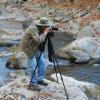
Good morning all. I'll start with a photo of one of the many waterfalls we saw on our trip.
The only camera I took was my Z6 with a 24-200mm zoom and my 28-300mm zoom that I used with an adapter for the Z6. I wished more than once that I had my 120-600mm with me but I thought it would be too much trouble to bring. But next trip I am going to find a way. I took it with me to Texas but i had a camera case roll aboard which made it easier. This trip I just had a smaller camera backpack.
Bonehead play of the trip - and I am kind of embarrassed to admit this. We had stopped by the roadside, lots of birds, cliffs, crashing waves, etc. I spotted a Eurasian Oyster Catcher (I'll post some photos of one later). Really close, great photo op. Then it hopped up on a rock and just stood there. Click, click, click...
I was so proud, thought I had a classic shot. Moved on, taking more photos, when I noticed an "-E-" in the lower corner of the viewfinder. Hmmm, is my memory card full? I turned the camera off and back on, still there. So I decided to take out the memory card and put it back in and NO CARD!!! I had forgotten to put the card back in the camera the night before when I downloaded all the daily images. I was so upset with my self. I had opportunities later to get more shots of the Oyster Catcher but still... Anyway I discovered a setting on the camera that will not let the camera shoot if there is no card.
"A moment in time
Immortalized forever
With silver and light"
Oh my Don, I love camera goof stories. They make me feel like I am not the ONLY one out there who does this kind of stuff. The good thing about my camera is that it has slots for 2 SDS cards. So if you forget to put your card back in after you upload your photos, there is a spare already in the camera. But I am sure I could still mess that up too. Well, I am glad that you were able to capture another shot of the EOC. You sure did capture the image of the fall nicely. That is really a lot of water pouring over those cliffs. It appears that is the closest that you can get to the falls, am I correct? Are the falls used to generate power? It is a spectacular view.
I have a water view to share, but it is not moving, at least not in this photo taken with my fish eye lens.
This is the HURON Lighthouse Boat.
A little background: Lightships are floating lighthouses that are anchored in areas where it was too deep, expensive, or impractical to construct a lighthouse. Lightships displayed a light at the top of a mast and, in areas of fog, also sounded a fog signal and radio beacon. The fog signals used over the years consisted of bells, whistles, trumpets, sirens, and horns. Early fog horns were powered by steam and later by air compressors. The HURON Lightship sounded her fog horn signal in 3 second blasts every 30 seconds and was known locally as “Old B.O.” because of the familiar sound her horn made.
The HURON Lightship was the last operating lightship on the Great Lakes and served for over 50 years when she retired in 1970. For 36 of those years, she was stationed at Corsica Shoals, a sandy area 6 miles north of Port Huron. She was permanently moored in sand, along the banks of the St. Clair River in scenic Pine Grove Park, Port Huron, MI. There is an extensive collection of artifacts, including many model ships, as well as a live camera feed of the bottom of the river, taken off a camera positioned at the bow. It was dedicated in 1990 as a National Historic Landmark.
This was the first thing we photographed when our camera club arrived in Port Huron. This ship is now moored in the sand and is a MUSEUM! For $10 you can tour the inside. We chose not to do that since not everyone wanted to go. Maybe I will go out there by myself someday and see what is inside.
05-24-2023, 11:35 AM (This post was last modified: 05-24-2023, 11:37 AM by Dave.)
Don, what a fine photo. The blues and grays vs the browns work great, nice sky, and the composition is faultless. Clearly the white water of the wide falls is the COI, but I think that the smaller narrow waterfall to the right is important to the composition.
I too have forgotten to re-insert my card, and I also found a setting that stops the camera from taking shots if no card is present.
Lorell, I had never heard of a lighthouse boat. Clever.
I like almost everything about your photo: great clarity and colors and values, the vignette works very well, and as always well composed. But for some reason I've always hated the unnatural distortion that a fish-eye lens creates. This isn't a criticism of your photo - it's more about my personal (and probably unjustified) bias against the fish-eye look.
I had some computer problems earlier: the PC wouldn't recognize the keyboard. I tried changing the port it was plugged in to, but that didn't work. Fortunately I had a compatible old keyboard somewhere an the garage and a short search located it. It takes up too much space so I had to rearrange things a bit, and I don't like the soft feel when typing, but at least my PC system is functional again.
Can you stand another shot of the terribly misnamed African Iris? I took this one yesterday morning. We had a slight drizzle during the night which decorated the flower with natural water drops. It probably is about 10% to 15% too dark, but I do like the small reddish buds because they provide a wee bit of relief from all the green...
Don't blame me - I didn't vote for him!
Nikon D7500 with Nikkor 18-300 mm; PSE2021, PSCS5 Ny Flickr Albums
Don. A beautiful photo of a beautiful country! Too bad on the missing card. These things happen but thank goodness not often. I have had some too. Looking forward to more travel photos.
Lorell, a dramatic sky complementing a dramatic fish eye lens photo from the master! The blue buoy and the blue highlightes on the top of the posts and anchor add interest to the photo.
Yes, take the tour sometime. If you have never been on one you will find it quite interesting.
I am the opposite of Dave, I like the fish eye effect and you handle that lens well!
Dave, Maybe instead of African Iris they should name it Casper Iris. Looks like a head shot of Casper the Friendly Ghost! It is a unusual flower for sure! Well presented with the extreme contrast!
WE had a visit from The Frankmobile...AKA.. the Wienermobile yesterday. Grocery store parking lot.
Nice shot of the Frankmobile. (Really dumb name change, IMO.)
I mentioned a keyboard problem I had. I just spent the last 6 hours struggling to fix another PC FUBAR problem: my display suddenly turned black and white. I Googled the problem and read that sometimes installing new hardware can cause this, but I can't understand why a keyboard switch should have any impact on color display. Anyway, I found instructions on how to fix the problem; a simple procedure that I tried many times over many hours without success. I took a break, then gave it more tries, following the same instructions. After many repetitions, it worked.
Don't blame me - I didn't vote for him!
Nikon D7500 with Nikkor 18-300 mm; PSE2021, PSCS5 Ny Flickr Albums
05-24-2023, 06:35 PM (This post was last modified: 05-24-2023, 07:01 PM by Man From Ironbark.)
Lorell, Iceland derives it's electricity from the geothermal that they live upon. Iceland is also a place of stunning natural landscapes, as Don is capturiing so well.
I do llike your boat photo Lorell and I don't share the dislike Dave as for wide angle distortion inall images. As an art form it stands for itself. I'm not a fan of it's use in photos of straight things like buildings. I've never purchased a wider lens than a 28mm. Perhaps because I thought the purchase of a wider angle was outside my financial capability because I'd use it rarely and thus had less justifcation to spend money on.
Dave, that iris is the one bright spot in the depths of darkness. I like it. The leaves in the darkness take the viewer deeper.
Living in rice growing country has a few downsides. The smoke from the burning stubble after harvest can be harmful as it contains high levels of silica particles. However it can also create the scope for images like these. In the first image there is a small part of a local winery visible.
Dave, Photography, like other are forms, is very subjective. Please do not apologize for not being a fan of the fish eye lens. My brother, who is an engineer, is not a fan either as everything needs to be perfectly straight and exactly represented in the photo as it is in real life. But foe me, tHe fish eye is another way of adding an artistic touch and you know why I enjoy it so much. But please don’t feel bad and please continue to share your reactions to my art forms.
Dave, You once again grabbed the right light for your Iris. It sure looks like a scary face though in this photo. Your iris reminds me, I have yellow iris in my front yard that is calling me.
Rich, I just heard about the name change to the “wiener mobile” to FRANK. When I visited the Henry Ford Museum last year they had the wiener mobile on display. I wonder if they have changed its name on that one too. I wonder how many Weiner Mobiles got a new name. I might just have to look that up.
Peter, great colors in your skies. But Peter, I do not understand when you wrote, rice country”. I thought rice needed wetlands, marshes, etc. I thought it was very dry where you live.
05-24-2023, 09:22 PM (This post was last modified: 05-24-2023, 09:24 PM by Man From Ironbark.)
(05-24-2023, 08:40 PM)Luv2shoot Wrote: Wow, I enjoyed the variety in today’s thread.
Dave, Photography, like other are forms, is very subjective. Please do not apologize for not being a fan of the fish eye lens. My brother, who is an engineer, is not a fan either as everything needs to be perfectly straight and exactly represented in the photo as it is in real life. But foe me, tHe fish eye is another way of adding an artistic touch and you know why I enjoy it so much. But please don’t feel bad and please continue to share your reactions to my art forms.
Dave, You once again grabbed the right light for your Iris. It sure looks like a scary face though in this photo. Your iris reminds me, I have yellow iris in my front yard that is calling me.
Rich, I just heard about the name change to the “wiener mobile” to FRANK. When I visited the Henry Ford Museum last year they had the wiener mobile on display. I wonder if they have changed its name on that one too. I wonder how many Weiner Mobiles got a new name. I might just have to look that up.
Peter, great colors in your skies. But Peter, I do not understand when you wrote, rice country”. I thought rice needed wetlands, marshes, etc. I thought it was very dry where you live.
Lorell. Where I live is naturally semi-arid. However, it is also the place where irrigation started in my state. Before the Snowy Mountains Scheme was completed, water was already being diverted to irrigate otherwise dryland areas.
Quote:The construction of the Snowy Mountains Hydro-electric Scheme is a well-documented part of our nation’s history and a leading example of Australian innovation and ingenuity.
The Snowy Scheme was an idea to capture and move water from east to west well before Snowy Hydro became an end-to-end, integrated energy business.
As far back as the 1880s, Australians had been considering diverting water from some of Australia’s best-known rivers – the Murray, Murrumbidgee, Snowy and Tumut – to drought-proof parts of NSW and Victoria.
However, it was not until 1944 that Commonwealth and State governments formed a committee to examine the development of water resources in the Snowy Mountains area.
As a result of their work, on 7 July 1949, the Commonwealth Parliament passed legislation to establish a Statutory Authority and start construction of the Snowy Scheme.
On 17 October 1949, Governor-General Sir William McKell, Prime Minister Ben Chifley and Snowy Mountains Hydro-electric Authority Commissioner William Hudson fired the first blast at Adaminaby, NSW. Construction was completed in 1974 at a total cost of $820 million. On completion, the Scheme consisted of seven power stations, 16 major dams, 80 kilometres of aqueducts and 145 kilometres of interconnected tunnels.
For Australia, this was more than just an infrastructure project. In many ways, it shaped parts of our nation’s history.
The Murrumbidgee Irrigation Area expanded as the Snowy Hydro was built.
Though I don't actually have an irrigation license. Therefore my place is naturally dry.
The irrigators can grow just about any crop due to the 300+ sunny days a year. Rice was big here until the large expanses of water caused salinity to rise and the price of the water began to exceed the profits to be made. Rice production still exists here though many of the original rice farms are now planted with more permanent plantings of grapes, citrus, almonds and olives.
The demand for locally produced rice has risen again and a few more farmers planted rice this season.