
+- Foto Friends (https://www.fotofriends.net)
+-- Forum: Photo Forums (https://www.fotofriends.net/forumdisplay.php?fid=14)
+--- Forum: Daily pub chat (https://www.fotofriends.net/forumdisplay.php?fid=10)
+--- Thread: Tuesday October 7 2025 (/showthread.php?tid=1221)
Tuesday October 7 2025 - Dave - 10-07-2025
Good day or evening.
Two more from my archives:
1. Red poppy from the same bed in front of neighbor's house, taken a couple of days after the Bees & Poppies photo I posted a few days ago...
2. Salsa ingredients, taken 2017-01-26...
I hope all are doing well.
RE: Tuesday October 7 2025 - Man From Ironbark - 10-07-2025
Pretty Flanders Poppy and FOOD.
 Nice work Dave.
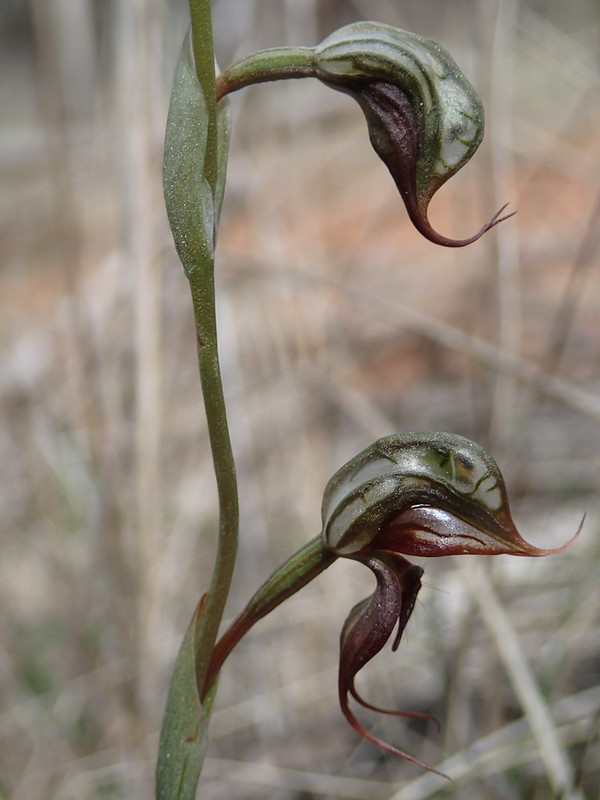
This small orchid is called the large-lipped rusty hood. Belongs to the Pterostylis: Greenhood orchids. They trap insects to gain pollination then release them.
iNaturalist Wrote:The insect then enters the flower and either because it has passed a balance point, or because it has touched a sensitive part of the labellum, the labellum moves forward trapping the insect between the column wings, the labellum and other flower parts. Observation of the insect's reaction to entrapment is difficult to observe, but in its struggle to escape, it either deposits pollinia from a previously visited flower or contacts the sticky viscidium and pollinia are attached, then carried to another flower. The features of an actively-moving labellum, along with the galea, are unique to these orchids.


RE: Tuesday October 7 2025 - Dave - 10-07-2025
Thanks MFI.
Fascinating info about the orchid.
The more I learn (much of it I've learned from you - thanks) about the clever adaptions in the natural world, the more I'm in awe of the wonders of evolution.
Nowhere is it more striking than in the complicated and very successful co-evolution of flowers and their pollinators. Some hummingbirds evolve long curved beaks that perfectly fit the structures of certain flowers - to the benefit of both. The same things is true about numerous insect pollinators.
RE: Tuesday October 7 2025 - Man From Ironbark - 10-07-2025
Yes. Orchids in particular tend to lure insects in with pheremones and flower shapes that get male insects wanting to have sex with a flower.
RE: Tuesday October 7 2025 - Rich - 10-07-2025
Beautiful Poppy Dave! The reds are perfect!
I am still amazed you make your own Salsa. I bet it is a whole bunch better than store bought.
Peter, interesting process of pollination!
Nothing new here except we went from summer to fall overnight. Cold front whipped through. About a 30 degree drop in temps.
RE: Tuesday October 7 2025 - Man From Ironbark - 10-07-2025
The stuff about how our planet works is all important not only to myself but to all future generations.
ie: A preliminary study has found several Australian orchid species have suffered a 60 per cent decline in pollen movement and fertilisation since 1925.
The biggest drop in pollination started in the 1970s, with researchers suggesting rising temperatures and land clearing may be contributing factors.
About 90 per cent of flowering plants rely on pollination to reproduce.
And a growing body of research in the US and western Europe indicates both regions are suffering a pollination crisis that could threaten agricultural productivity.
Study co-author and ecologist Joanne Bennett, from Charles Sturt University, said the biggest decline in pollination started in the 1970s.
She said the most significant declines were in "natural" areas not disturbed by landclearing or development.
"It seems like [the cause] has to be something big that is overriding everything," Dr Bennett said.
"Historical land-use change caused orchid pollination to decline, but now the main driver is climate, and that's what's changed."
Australia, on average, has warmed 1.51 degrees Celsius since national temperature records began in 1910, with an intensification of the trend beginning in the 1950s.
Dr Bennett said she was not sure if orchids could be as successful in the future.
https://www.abc.net.au/news/science/2025-10-08/rapid-pollination-decline-in-australian-orchids-since-1970s/105835594